
Published on 03/12/2025
Electoral Commission (EC) is seeking an additional UGX 469.5 billion in supplementary funding to organise the January 2026 general elections, with the bulk, UGX 268.38 billion, earmarked for acquiring Biometric Voter Verification Kits (BVVKs) featuring enhanced technology for polling day.
Another UGX 19.6 billion is required to purchase a new de-duplication system designed to detect and eliminate multiple entries of the same voter from the register.

Kamugisha told MPs that earlier consultations had raised doubts about the reliability of using Uganda Bureau of Statistics (UBOS) tablets for voter verification, prompting Cabinet to order the deployment of dedicated biometric machines instead.

“Cabinet resolved that for the conduct of the 2025–26 elections, the EC must deploy mandatory biometric voter verification machines,” he said. “To effectively verify every voter at the polling station, the Commission undertook processes that increased the budgetary requirements for the current financial year.”
He noted that using mandatory biometrics requires faster processing of voters, necessitating the splitting of overcrowded polling stations. “Each voter will take about 30 seconds to be verified. To ensure everyone votes between 7am and 4pm, we split polling stations so that none, except in highly urban areas, has more than 600 voters,” he said. “This led to the creation of 15,256 additional polling stations.”
The Commission asked for UGX 2.4 billion to publish the newly created polling stations in the national Gazette and a further UGX 1.2 billion for publication in local dailies as required under electoral law.
But MPs questioned whether newspaper adverts adequately reach rural voters. Agnes Apea (Amolatar District Woman MP) noted: “Our rural voters do not have access to some of these publications.”

Others queried whether the EC was avoiding certain newspapers. Ssemujju Nganda (Kira Municipality) asked whether the Commission would advertise in the Daily Monitor, which has faced advertising restrictions from State House and Parliament.
Kamugisha replied: “We are not only advertising in the New Vision. We are also advertising online, on radio, and pinning notices at district offices. We have nothing against the Daily Monitor, we have published with them before.”
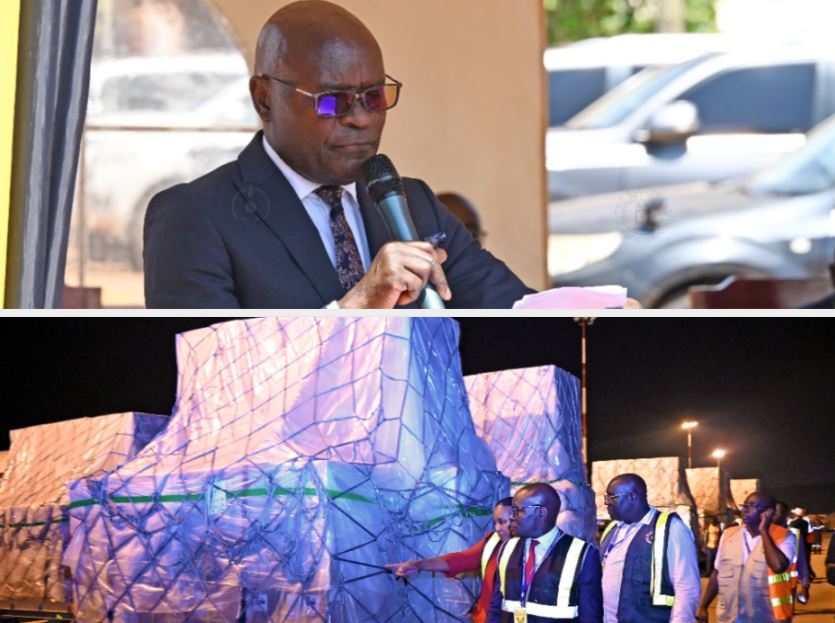
Kamugisha informed the Committee that the EC has already procured 109,000 BVVK tablets at a cost of UGX 268.38 billion. The new devices are an upgrade from those used in 2021 and include comprehensive biometric features to ensure “one person, one vote.” “The machine will identify a voter using all fingerprints, and if that fails, it will use the photograph. The BVVK has an in-built camera. If a person lacks fingerprints, their photo will be matched with the national voters’ register,” he said.
The tablets are also fitted with a machine-readable barcode system to validate ballot papers. “Each ballot will have a unique barcode. Before being issued, it will be authenticated by the machine. At counting, the machine will confirm that the ballot being tallied is the same one validated earlier. Any alien ballots will be rejected.”
Budget Committee Chair Patrick Isiagi and other MPs questioned whether the system could be used to trace which candidate a voter supported. “So, if Musasizi goes to vote, can we later trace that ballot and know who he voted for?” Isiagi asked.
Kamugisha denied any linkage between voter identity and ballot validation. “Identification of the ballot is not linked to the voter. The machine only confirms that the ballot was authenticated, not how it was marked.”
However, MPs, including Minister of State for Finance Henry Musasizi, remained sceptical, wondering how ballot stuffing is still possible under a fully biometric system.
Kamugisha argued that while ballots are validated, the system is designed to detect, not prevent, attempts at stuffing. “The principle is one person, one vote. Voters are biometrically verified, ballots are machine-validated, and at counting, only validated ballots will be accepted.”
When Minister Musasizi pressed for clarity, Ssemujju questioned why a Cabinet minister was raising concerns in Parliament instead of earlier in Cabinet. “Are we proceeding well when the minister brings a supplementary request and also asks questions? A supplementary is a process,” Ssemujju said.
“In Cabinet he focuses on financing and macroeconomic issues. Here, he is also a candidate and has a right to seek clarity. It is proper for him to do so.”
To ensure compliance with mandatory biometric verification, Kamugisha said each polling station will receive two tablets, plus additional backup devices at the constituency level. “These tablets will be fitted with power banks to ensure constant power supply throughout polling,” he said.