
Published on 19/11/2025
President Yoweri Museveni has instructed newly-elected NRM district chairpersons to fully penetrate every village and workplace in their jurisdictions as the party launches an intensified grassroots mobilisation strategy ahead of the 2026 elections.
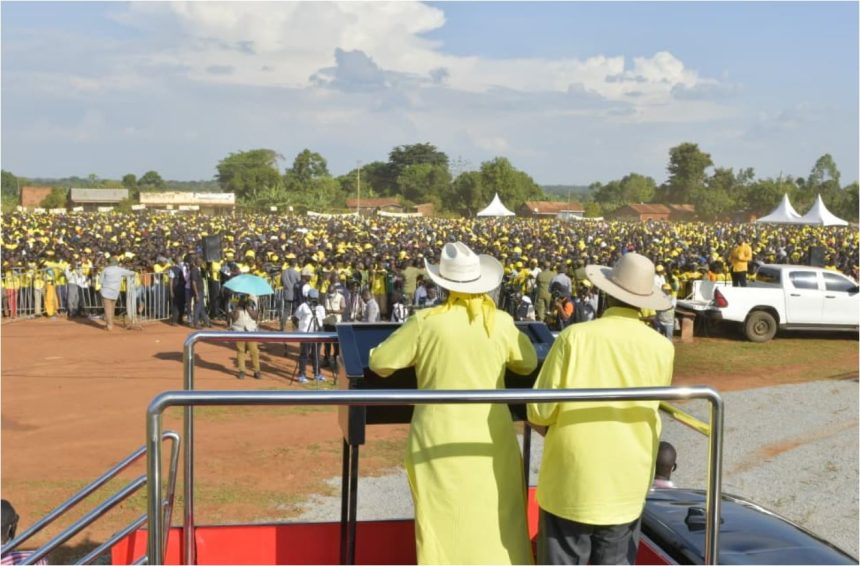
Speaking while flagging off the nationwide mobilisation drive on Tuesday evening at Mayuge State Lodge, Museveni congratulated the district party leaders—most of them young—but reminded them that leadership required ideological grounding, not merely youthfulness.

“You cannot simply say, ‘We are young.’ Youth is biology; politics needs ideology,” he said. “It is important that you understand the ideology of the NRM.”
The President unveiled a detailed message that district chairpersons and their teams will take to parishes, villages and workplaces, noting that the strategy was designed after extensive consultations.
He emphasised that the most effective campaign method was to reach people where they live and work.
Museveni directed the leaders to ensure that factories, hotels, markets, schools, and other workplaces have resident party mobilisers.
He also highlighted the existing patriotic clubs in schools as structures the NRM should use to reach young people, even those who do not vote yet.
Beyond workplaces, Museveni urged chairpersons to engage grassroots influencers such as taxi drivers who interact with hundreds of travellers daily.
Under the new strategy, mobilisation teams will operate parish by parish, meeting the 63 persons per village and equipping them with both verbal and written messages. Given that parishes generally consist of about five villages, Museveni said this method would allow the party to interface with close to 400 local leaders at once, ensuring message accuracy and consistency.
The President said the campaign message highlights the NRM’s achievements—including increased factories, schools, health centres, and road infrastructure—while also addressing challenges such as delayed road reconstruction.
He attributed some delays to “poor prioritisation” by civilian leaders who “scatter resources in pursuit of cheap popularity,” instead of strictly following the NRM’s principle of prioritisation.
“We, the bush people, believe in doing the most important things first with the little money available,” he said, emphasising that roads must take precedence over salaries and new administrative units.
Museveni dismissed claims by opposition presidential candidates, whom he accused of peddling falsehoods and serving foreign interests that “fear Uganda becoming strong.”
By empowering the 63 village-level leaders and ensuring each mobilises even three additional supporters, Museveni projected that the NRM could directly reach at least 14 million Ugandans across the country’s 72,000 villages.
He added that while voluntary mobilisation groups are free to continue supporting the party, the new approach will ensure that elected party structures finally take full responsibility for mobilisation work.
“For the first time, those elected to do the work will be deployed to actually do that work,” Museveni said. “If someone is elected to do something, let him do it.”
According to Rt. Hon. Richard Todwong, the NRM Secretary General, the drive is aimed at ensuring that the district campaign committees continue hunting for votes after the presidential candidate’s rallies.
Present at the launch were CEC members, members of the NRM Secretariat top leadership, district/city chairpersons and sub-regional coordinators of the exercise.